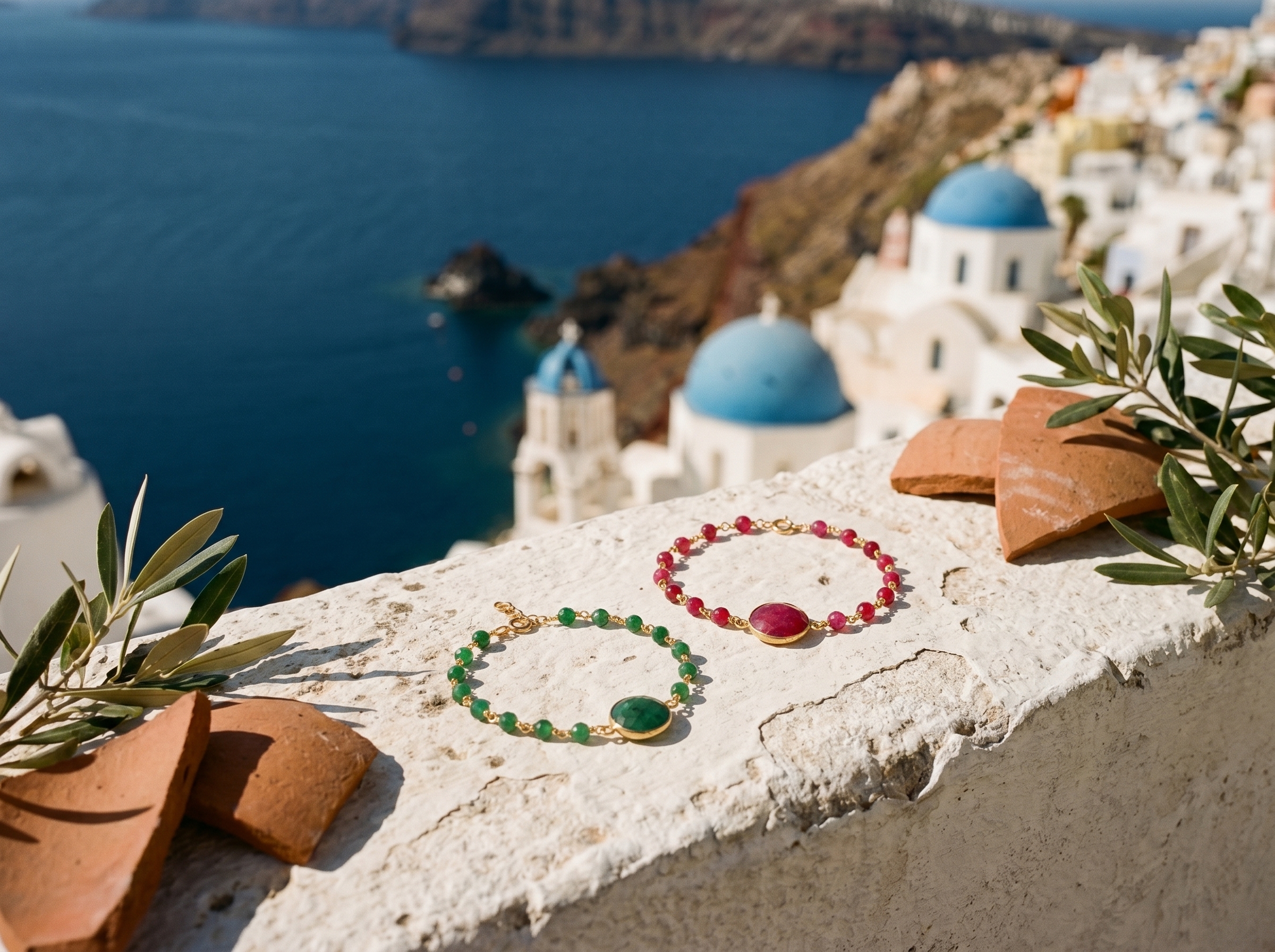
"Gold-plated" and "gold" are not the same thing. Neither are "silver-plated" and "silver". Five different terms circulate in the market's display cases, and the confusion costs money and disappointment. In this guide, you'll see exactly what each means, how long it lasts, who it suits — and which option truly offers value for your money.
First, the basics: what is "pure" gold?
Pure, 100% gold (24K) is too soft for jewellery — it bends with a finger. To make it durable, it's mixed with other metals (copper, silver, palladium) in different proportions, measured in karats (K).
- 24K: 100% gold — investment grade, not for jewellery.
- 18K: 75% gold — premium, pan-European high-jewellery standard.
- 14K: 58.5% gold — the most popular choice in the USA and modern brands.
- 9K: 37.5% gold — European entry-level, the minimum legal content to be called "gold" in Greece.
All of the above are solid gold — the gold is within the metal itself, not just on its surface.
Gold-Plated
Gold-plated is a base metal (usually silver or brass) that has been coated with a thin layer of gold — from 0.5 to 2.5 microns.
| Composition | Base metal + thin gold plating |
| Lifespan | 1-3 years with normal use |
| Price | € |
| Ideal for | Trend pieces, experimenting with gold tones without high cost |
At Liora, all gold-plated pieces have a 925 silver base — not brass. This means that even when the plating wears off, the jewellery remains authentic silver, without allergenic nickel. See for example our gold-plated bracelets.
Vermeil — a special category of gold-plated
Vermeil (pronounced "ver-may") is gold-plated with strict specifications: a base of pure 925 silver, a gold plating of at least 2.5 microns, and a minimum quality of 10K. It is the premium category of gold-plated and lasts 3-5 times longer than common gold-plated items.
Silver-Plated
Analogous to gold-plated, but with silver instead of gold: a base metal (copper, brass) with a thin silver coating.
| Composition | Base metal + thin silver plating |
| Lifespan | 6 months - 2 years. Fades quickly, revealing the inferior metal. |
| Price | € (the cheapest) |
| Ideal for | Costume jewellery to be worn a few times — not for daily wear |
Attention to marking: many jewellery pieces on the market are sold as "silver" without even being silver-plated — they are simply polished base metal. If there is no 925 stamp on the piece, it is not authentic silver, even if it shines like it.
925 Silver (Sterling Silver)
Solid authentic silver with 92.5% pure composition. The international standard for all quality silver jewellery.
| Composition | 92.5% silver + 7.5% other metals |
| Lifespan | Lifelong with basic care |
| Price | €€ |
| Ideal for | Everyday jewellery, lasting decades, sensitive skin (hypoallergenic) |
925 silver tarnishes over time — this is not a defect, it's a reaction with air and can be corrected in minutes with a polishing cloth. All Liora silver pieces bear the 925 stamp.
9K Gold
The legal limit for a piece of jewellery to be referred to as "gold" in Greece and most European countries. It contains 37.5% pure gold mixed with copper, silver, and zinc.
| Composition | 37.5% gold + 62.5% other metals |
| Lifespan | Very long — more durable than 18K and 14K due to lower gold content |
| Price | €€€ |
| Ideal for | Investing in real gold, without the cost of 14K or 18K |
Important: 9K gold has a more "yellow-cool" hue than 14K and 18K, which are more "richly warm". It is not inferior — simply a different tone.
Comparison table at a glance
| Material | What it is | Durability | Cost |
|---|---|---|---|
| Silver-Plated | Silver coating on copper/brass | Months | € |
| Gold-Plated | Gold coating on 925 silver | 1-3 years | €€ |
| Vermeil | Thick gold plating on 925 silver | 5-10 years | €€ |
| 925 Silver | Solid authentic silver | Lifelong | €€ |
| 9K Gold | Solid 37.5% gold | Lifelong | €€€ |
How to choose
If you wear it daily
925 silver or vermeil. They will withstand friction, sweat, and frequent hand washing. Avoid simple silver-plated — it will peel within weeks.
If you want the gold tone without high cost
Gold-plated on 925 silver. It lasts reasonably, retains its value, and if the plating eventually wears off, the jewellery remains useful (authentic silver).
If you are buying for a special occasion or gift
9K or 14K gold. An investment in real gold that retains its value and can become a family heirloom.
If you have sensitive skin
925 silver, vermeil, or 14K gold and above. Avoid silver-plated and cheap gold-plated items — their base often contains nickel, which causes allergies.
Frequently Asked Questions
How do I check if a piece of jewellery is real 925 silver?
Look for the stamp "925", "STER", "Sterling", or "S925" somewhere on the piece — usually on the clasp or inside. In Greece, every authentic piece of jewellery must bear a quality stamp.
Does gold-plated jewellery wear off? How long does it take?
Yes, gradually. With normal use (daily jewellery), the gold plating wears off in 1-3 years. With care regarding perfumes and sweat, it can last up to 5 years.
Can I re-plate gold jewellery?
Yes — most silversmiths and goldsmiths offer re-plating services for 15-40€ per piece. It's an investment worth making if the jewellery has sentimental value.
Which is best for children?
925 silver. It is hypoallergenic, economical compared to real gold, and if lost, it's not the end of the world. Silver-plated items are a bad idea — their bases often contain nickel.
Conclusion
There is no "better" — there is the right material for the right use. For everyday pieces, we recommend 925 silver or gold-plated on 925. For investment or lifelong gifts, 9K gold and above. What you should almost always avoid is simple silver-plated on brass — it will disappoint you in a few months, and ultimately costs more because it forces you to buy again.
The next article will explain what the various stamps (925, 750, 585, 375) mean and how to identify authentic jewellery in the market.